Flat and oval bottles
Front and back label placement for personal care, household, food, beverage and chemical bottles where retail presentation matters.
Applications
Use the pack format and labelling requirement to choose between twin-side labelling, compact systems and top/bottom labelling machinery.
Front and back label placement for personal care, household, food, beverage and chemical bottles where retail presentation matters.
For round containers where two separate labels are required instead of a single wrap-around label.
Top and bottom labelling for flat packs, sleeves, trays, boxes and food packaging requiring two-face application.
Transparent labels may need specialist sensing and setup to detect the label edge and hold registration.
Labelling systems can be planned with coding or inspection where batch, date or barcode control is required.
Connect the labeller into a wider line after filling, capping, sealing or inspection equipment.
The right labeller depends on the way the pack moves through the machine. Container stability, label wipe-down, side guides, top hold-down and label sensor selection can all affect the result.
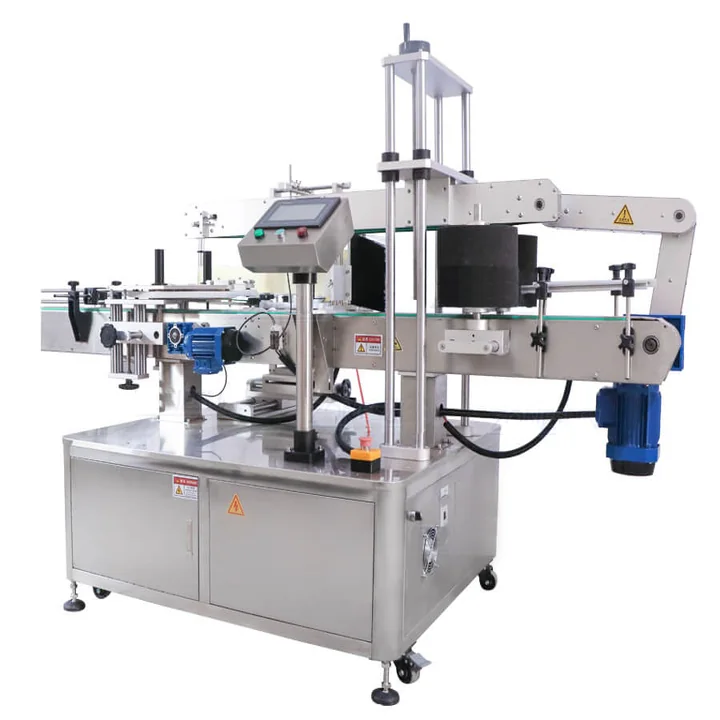
Send photos or drawings of the pack and labels. Lancing UK can advise which labelling route is most suitable.
Application routes
Choose a route by product shape to help narrow the right front/back labelling machine.
For flat and rectangular containers.
For shaped packs that need extra guide control.
For two separate labels on round bottles.
For top, bottom and flat-face labels.
Front/back labelling for flat-sided rectangular bottles.
Guidance for square and multi-panel containers.
Plan front/back labels for glass bottles and premium packs.
Front and back labelling for plastic bottles, pumps and triggers.
Two-label routes for jars and rigid containers.
Apply separate front and rear labels in one pass.
Alternative search route for twin-side bottle labellers.
Choose side or top/bottom labelling for flat products.
More buyer routes
These additional pages target specific buyer searches while keeping the same site design and project enquiry path.
Shampoo and conditioner bottles often use shaped or flat-sided packaging that needs careful guide control. Front and back labels must align cleanly with the bottle panel…
Lotion bottles, pump bottles and personal care packs need tidy label placement because the finished pack is judged visually at shelf level. A twin-side labeller can apply…
Detergent and household cleaning bottles can be heavy, handled in damp environments and use labels that must remain readable. The machine route should consider label mate…
Trigger spray bottles require label alignment around bottle shape, handle geometry and cap orientation. The project should confirm whether the label is aligned to the bot…
Sauce, dressing and condiment bottles often need clean branding, ingredients, nutrition and barcode labels. Bottle shape, product residue and wash-down expectations shoul…
Glass jars can require front branding labels, rear ingredients panels or tamper-related label positions. The best route depends on jar diameter, panel shape, label materi…
Candle jars and home fragrance containers often use premium labels where placement and presentation quality matter. The applicator should be matched to glass, coated or t…
Paint tins, cans and similar containers need durable labels and stable handling. The project should confirm container shape, weight, surface finish and whether labels are…
Small bottles need precise handling because small label errors are more visible and there is less surface area for correction. A compact or automatic route may be selecte…
Square jars and square bottles give useful flat label panels but still need accurate guidance so labels do not skew across corners or raised areas.
Tapered bottles can make label placement more difficult because the label face is not parallel from top to bottom. Machine trials help confirm label shape, wipe-down and…
Flat cartons, sleeves and retail-ready packs may need labels on the top, bottom, side or both faces. The best route depends on product presentation, conveyor support and…
Barcode labels require consistent position and scannability. The applicator should be configured around label size, print/coding needs, pack orientation and inspection re…
Ingredient, safety and compliance labels are often applied to the rear of bottles, jars and packs. The machine must keep the label readable, square and correctly position…
Container-shape engineering
Two containers with similar overall dimensions can behave differently on the conveyor. Panel flatness, moulding variation, base stability, shoulder shape and the filled weight influence guide, belt and wipe-down settings.
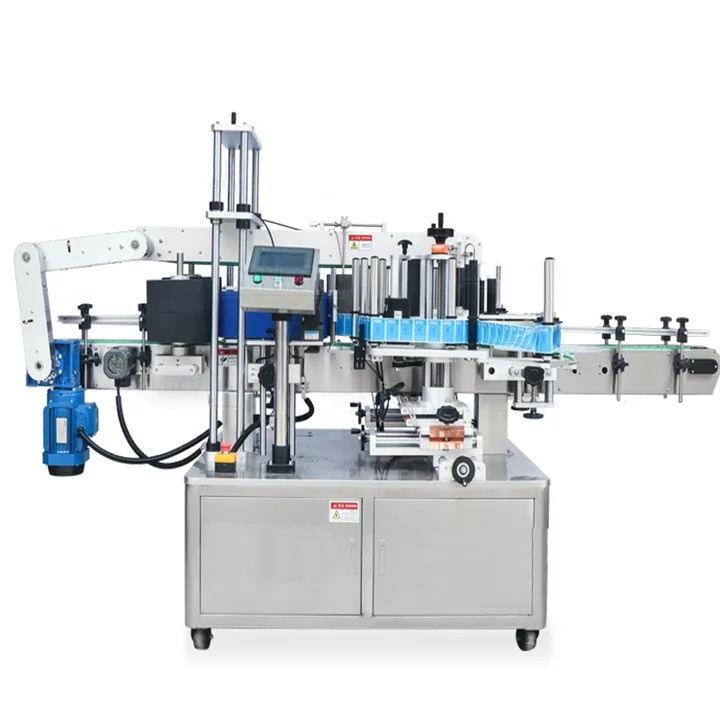
Existing labelling-machine photograph. Agree fixed pack datums and horizontal and vertical placement limits, then measure both labels on production samples.
| Pack stability | State whether the product rocks, flexes or changes shape when side pressure is applied. Filled and empty packs can behave differently. |
|---|---|
| Surface condition | Declare moisture, oil, powder, mould-release residue, texture or low-surface-energy plastic so label adhesion can be considered. |
| Label position | Supply annotated photographs or drawings for both faces, including the datum and any keep-clear area around seams, handles or embossing. |
| Multiple labels | Confirm whether front and back labels are different sizes, use separate rolls, need barcode orientation or require a third application face. |
| Trial samples | Send representative production variation, not only a perfect sample. Include the intended cap or closure and the real label roll. |
Handled and multi-label packs
Heavy, asymmetrical or three-label containers should be qualified with the finished pack and production label rolls.
Handles, filled weight, broad labels and recessed panels.
Multi-head sequencing for a third bottle label.
Configuration-led routes for additional label faces.
Further technical guidance
The same bottle can need a different material review when the rear label becomes a booklet, the artwork becomes metallic or the usable panel is tapered.
Review thickness, opening tabs, sensing and finished-pack checks before selecting the label application route.
Review extended-content applicationDefine roll-end response, incomplete-pack control and first-off approval after restarting a twin-side line.
Plan material-change recoverySeparate panel geometry from unstable presentation before changing artwork or machine settings.
Review tapered-pack qualificationSensor selection · Label-roll specification · Send an application enquiry