Dual heads
Independent labelling heads apply front and back labels in one pass.
Automatic range
High speed twin-side labelling for front and back labels on bottles, jars, flat packs and shaped containers.
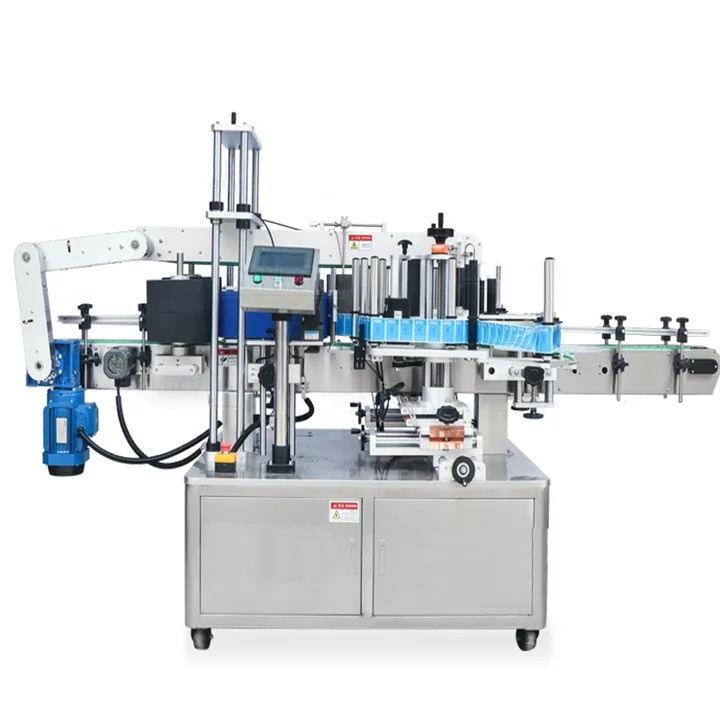
Machine features
Automatic front and back labelling machine for flat, oval, square and round containers requiring simultaneous twin-side label application.
Independent labelling heads apply front and back labels in one pass.
Guides and top hold-down support flat, round and shaped containers.
Suitable for standard labels, transparent labels and registration control.
Stable machine build for consistent higher-speed production.
Touchscreen recipe storage makes repeat jobs quicker to set up.
Pairs with filling, capping, inspection, coding and conveyors.
Specification
Reference specifications are provided to help with early selection. Final machine specification depends on container dimensions, label material, label size, application position and required output.
| Application | Front/back on flat or round bottles |
|---|---|
| Label type | Paper or film; normal and transparent labels |
| Accuracy | High precision, specification dependent |
| Speed | High speed, model and label dependent |
| Controls | PLC with touchscreen HMI |
| Voltage | Typically 220 V |
| Conveyor | Side belts/top hold-down available |
| Bottle shapes | Round, square, flat and oval |
| Options | Date coder, inspection, clear-label sensor |
| Changeover | Tool-less adjustment points where specified |
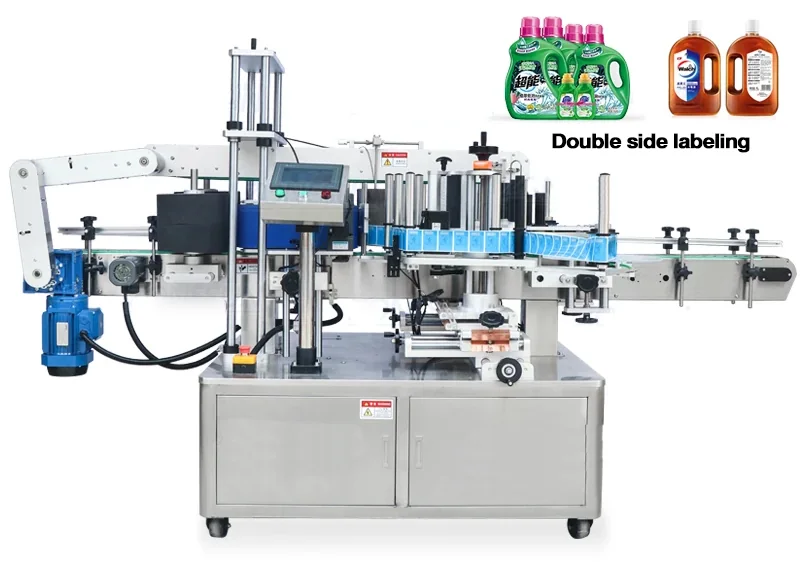
Applications
Tell us your container shape, dimensions, label material, label size, label position, target speed and whether the labeller needs to connect with a filler, capper, coder or inspection system.
Engineering specification notes
The LUB963 reference system identifies the machine family, but final performance is determined by the container, two label rolls, handling method and the agreed line conditions.
Each applicator is positioned for its own label size and target location. This allows the front branding label and rear information label to differ, but it also means both heads must be set from a common product datum. The conveyor guides and stabilisation belts should hold the pack without distorting it or allowing rotation as the labels contact the surface.
For oval and shaped bottles, the first point of label contact, belt pressure and wipe-down path are especially important. For tall or light packs, a top hold-down may be considered. The correct arrangement should be proven on representative samples rather than inferred from overall dimensions alone.
Existing labelling-machine photograph. Confirm guides, belt positions and label-head settings using the real pack and production label rolls.
Record core diameter, outside diameter, web width, label gap, pitch and winding direction for both rolls. Declare paper, film, metallic or transparent constructions before sensor selection.
Agree the normal production rate, pack spacing and measurement method. Test both heads through normal starts, stops and continuous running, then measure a stated sample from fixed datums.
Identify every SKU, pack size and label pair. Review adjustment points, recipe storage, label-roll access and how operators will restore guide and head positions after a changeover.
| Upstream equipment | Filler, capper, rinser or unscrambler output, product pitch and any accumulation before the labeller. |
|---|---|
| Conveyor interface | Direction of travel, working height, available length, side transfer and product hand-off. |
| Coding and inspection | Date or batch code location, print field, camera view, barcode orientation and reject method where required. |
| Controls | Start/stop interlocks, line-ready signals, speed reference, emergency-stop philosophy and any customer control standard to be reviewed. |
| Trial basis | Representative containers, production label rolls, agreed normal speed, placement datums and a documented sample check. |
Specification questions
These answers explain the information needed before output, sensing and integration can be confirmed.
Flat, oval, rectangular, square and selected round containers can be considered. Suitability depends on a stable contact area, repeatable orientation and enough space for the front and back labels.
Each label head is adjusted independently while guides, side belts and any top hold-down stabilise the pack. Alignment should be verified from agreed container datums during a sample run.
Not in every case. Opaque labels may work with conventional gap sensing, while transparent label and liner combinations can require a specialist clear-label sensor and testing with the production roll.
Container stability, label length, product spacing, dispense speed, wipe-down time, coding, inspection and the surrounding line all affect sustainable output. The agreed rate should be demonstrated with the real application.
Supply representative containers in the condition used at labelling, both production label rolls, drawings or dimensions, annotated label positions and details of the required line speed and interfaces.
Yes, the machine can be considered as a standalone unit or as part of a line. Conveyor height, direction, speed control, product spacing, coding and inspection interfaces should be confirmed during specification.
Automatic system acceptance
An automatic front and back labeller should be assessed as a product-handling system, not only as two label heads. Sustainable output and placement depend on the pack entering at the right spacing, remaining stable through both dispense points and leaving without disturbing freshly applied labels.
Use representative containers in the state used on the production line. Filled weight, closure fit, temperature, surface condition and bottle flexibility can alter how the pack reacts to side belts, guides and wipe-down pressure. Both production label rolls should be used because their materials, lengths and release characteristics may be different.
The trial speed should describe a normal sustainable rate, including realistic product spacing and any upstream or downstream constraint. A short burst at a higher conveyor speed is not the same evidence as stable running with product detection, label dispensing, coding and inspection active.
Front and back placement should be recorded separately. Choose repeatable horizontal and vertical datums on the container, define the nominal label position and record the allowed tolerance before the run begins. For oval, flexible or tapered packs, include several samples across the normal manufacturing variation.
Use the same method after a recipe recall or mechanical changeover. This shows whether settings can be repeated by the intended operator rather than only by the engineer who completed the first setup.
| Trial stage | What to keep representative | Evidence to record |
|---|---|---|
| Initial setup | Normal containers, both production label rolls, intended sensors and standard guides or belts. | Head positions, guide settings, roll direction, sensor settings and nominal placement datums. |
| Steady production | Normal product spacing, line speed and the intended coding or inspection functions. | Sustained rate, missed-product or missed-label events, label finish and placement from both heads. |
| Starts and stops | Normal operator controls and product accumulation conditions. | First-pack placement after restart, label feed recovery and any change in product orientation. |
| Changeover | A second agreed SKU or pack size using the intended tools and recipe procedure. | Adjustment sequence, repeatability, time-dependent bottlenecks and whether format parts are required. |
| Fault recovery | Safe simulation of a missing label, low label roll or product gap where the controls permit. | Alarm clarity, recovery steps and whether the next product remains correctly labelled. |
| Line integration | Upstream feed, downstream transfer, coding, inspection and reject interfaces. | Signals, conveyor-speed relationship, product spacing and behaviour during downstream stoppages. |
The automatic route is strongest where regular throughput, repeatable product spacing and integration justify controlled infeed, twin applicators and recipe-based changeovers.
Flat, oval and shaped containers can need different side-belt contact zones, guide pressures or a top hold-down. The real pack determines the configuration.
Check whether belts, rails, accumulation tables or packers touch the freshly labelled surfaces before the adhesive has fully settled.
Acceptance evidence
A twin-side machine can produce a good average result while one head, one label roll or one pack face creates the real limit. Record both sides separately during trials and acceptance.
| Front head | Nominal position, horizontal and vertical results, skew, label finish, sensor response and roll identity. |
|---|---|
| Back head | The same checks recorded independently, even where the artwork and label dimensions differ. |
| Pack control | Orientation, side-belt pressure, top hold-down, guide contact and movement between the two application points. |
| Combined output | Correctly labelled packs over a representative run, including stops, gaps and downstream restrictions. |
| Inspection and reject | Where included, verify pack tracking from camera decision to physical reject and confirm fault response. |
Operating questions
The answers below focus on one-head operation, unequal labels, product spacing and repeatable recipe control.
Many twin-head systems can be configured to run a job with one head active, but the exact control logic and safe operating procedure must be confirmed for the selected machine. The product path, detection sequence and unused head position still need to remain compatible with the pack.
Include one-label jobs in the sample trial if they are part of normal production.
Each application head should be set from its own label length, dispense distance and target datum. The longer label may require more dispense and wipe-down time, while the shorter label may finish earlier, so product spacing and conveyor speed must satisfy both sides.
The combined trial should record each head separately and confirm that one side does not become the hidden output limit.
Inconsistent product spacing can leave too little time for a label head to complete its cycle, create ambiguous product-detection events or cause packs to enter the stabilising belts while the previous pack is still controlled. The result may be a missed label, poor placement or a line stop.
Spacing should be treated as an upstream interface requirement, not only as a labeller setting.
Record label-head position, dispense delay, sensor teach values, guide widths, belt or hold-down positions, conveyor relationship and the identity of both label rolls. Mechanical positions that are not motorised need a repeatable reference such as a scale, counter or controlled setup sheet.
A recipe name alone is not enough when critical adjustments remain manual.
Architecture and line position
An automatic twin-side system is normally selected because the front and back application heads need independent position, reel and control settings while the pack continues through an inline process. That architecture should be confirmed against the actual label supply and the condition of the bottle at the application point.
Separate heads allow the two label rolls to be loaded and adjusted independently within the selected hardware ranges. This can be useful where front and back labels differ in height, length, material, artwork orientation or inspection requirement. It also means both web paths, sensors, peel plates and wipe-down settings must be included in changeover and acceptance testing.
Where both labels are deliberately printed alternately on one reel, a different handling and application sequence may be more appropriate. Use the single-roll versus twin-head guide before fixing the label artwork.
The same bottle can behave differently when empty, filled, capped, warm, damp or recently washed. Weight and rigidity affect side-belt pressure and orientation, while surface contamination can undermine label adhesion. A pump, trigger or overhanging closure can also change top hold-down access.
Use the labelling sequence guide to define the production condition that the machine trial must reproduce.
Two-head material control
An automatic twin-side labeller should be assessed with the front and rear label constructions independently. A paper front label paired with a layered rear label can create unequal reel capacity, clearance needs and change intervals. Compare the finished two-label pack through normal stops as well as steady running; independent heads do not mean that all label materials are interchangeable.
The line needs a defined stop or inspection-and-reject response so that front-labelled containers are not released as complete packs. Specify the containers remaining between the two application points and the first-off checks after material is restored. Low-roll warnings and missing-label control must be confirmed for the quoted configuration.
| Front applicator | Material, web width, pitch, liner, artwork identity and usable labels per roll. |
|---|---|
| Rear applicator | The same data, plus any booklet thickness profile, opening tab or special sensing requirement. |
| Complete pack | Paired artwork versions, both placement datums, inspection decision and controlled restart method. |
Use the booklet and peel-and-read qualification guide for layered rear labels and the reel-change recovery guide to specify stops, splices and incomplete packs.
Include the container, both label constructions, target output and any existing line constraints.