Shape control
The machine should support the product through the labelling zone without twisting or bouncing.
Oval bottle labelling
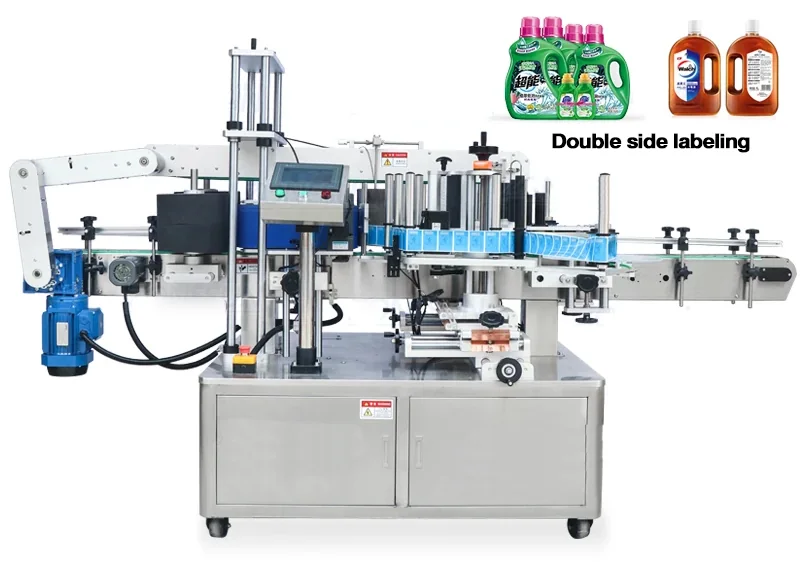
Oval bottles often need more control than flat containers because the product can rotate or move during label application. A front/back labeller should hold the container consistently while the two labels are applied to the intended panels.
Selection points
The machine should support the product through the labelling zone without twisting or bouncing.
Front and back panels must be clearly defined so the labels sit on the correct area of the bottle.
Sending bottle and label samples helps confirm the right handling and sensor configuration.
Related routes
Use these pages to compare similar pack formats and label application routes.
Front and rear labels on flat and rectangular containers.
Controlled labelling for shaped and oval packs.
Separate front and back labels rather than full wraparound.
Top, bottom and face labelling for flat products.
Send your pack dimensions, label size, label material and output target. Lancing UK can help shortlist the most suitable front/back labelling route.
Oval bottle engineering
An oval bottle does not present one constant radius to the labelling heads. As the pack moves, the contact point can shift from the broad face towards the curved edge. The handling system must keep the intended front and back panels aligned while allowing controlled wipe-down across that changing surface.
The widest part of an oval bottle may sit above or below the best guide-contact zone. If side rails touch only a narrow curved area, small changes in pressure can rotate the bottle. Lightweight packs can also lean under label-head or wipe-down pressure, while tall packs can move at the shoulder if the cap or closure is not controlled.
Side belts can provide a longer contact zone than fixed rails and can carry the pack through the two applicators at a controlled speed. A top hold-down may help where the closure and bottle height provide a reliable contact point. The correct arrangement depends on the real filled or empty container, not only its maximum width.
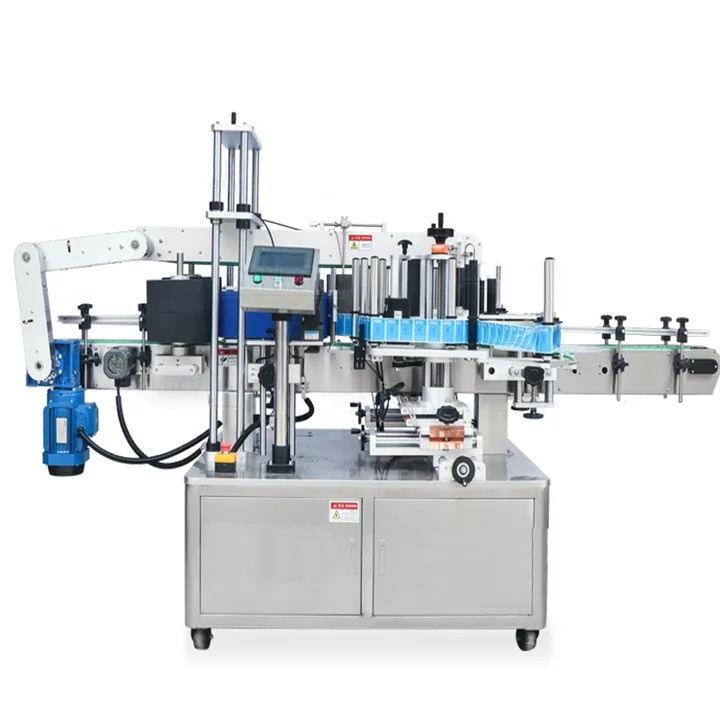
Existing labelling-machine photograph. Confirm guides, belt positions and label-head settings using the real pack and production label rolls.
| Container measurement | Why it matters for oval bottle labelling |
|---|---|
| Maximum and minimum width | Shows the degree of ovality and helps identify where guides or side belts can contact the pack without encouraging rotation. |
| Usable front and back panel | Defines the area where the label can be wiped down before the surface curvature becomes too strong. |
| Shoulder and heel profile | Limits the vertical label position and can cause edge lift where a label enters a compound curve. |
| Taper over label height | A changing width can alter pressure and create skew, bubbles or unequal label-edge contact. |
| Closure and overhang | Pumps, triggers or wide caps can prevent top-belt contact or alter the pack datum used for height adjustment. |
| Filled weight and centre of gravity | Influence stability, acceleration and the pressure the pack can tolerate without leaning or squeezing. |
| Front/back datum | A mould feature, panel edge or other repeatable point is needed to measure both label positions consistently. |
The trial should prove container control, sensing, label finish and repeatable changeover rather than only show that one bottle can pass through the machine.
Include dimensional variation, the intended closure and the filled or empty condition used at the labeller.
Front and back labels can have different lengths, materials, adhesive behaviour and sensor requirements.
Check the first containers after a restart, because product spacing and belt control can differ from steady running.
Return to a saved format or a recorded mechanical setup and confirm that both label positions are recovered.
Oval bottle questions
Yes, a twin-side system can apply two separate labels in one pass when the bottle can be held in a repeatable orientation and both label panels remain accessible to the applicators.
Not necessarily. Filled weight, centre of gravity and bottle stiffness can change how the pack responds to side belts, guides and wipe-down pressure, so the trial condition should match production.
They can be considered, but the label and liner combination may require a clear-label sensor. Production rolls and bottles should be tested because curvature and surface finish also affect the final appearance.
Supply representative bottles, front and back label specifications or rolls, marked label positions, target output, changeover range and details of any filler, capper, coder, inspection or conveyor that connects to the labeller.
Oval-pack datum
An oval bottle changes curvature continuously. The label should sit inside the area that can be contacted evenly while the bottle remains controlled between belts or guides.
Use the container panel design guide to mark radii and keep-clear zones, then use the placement guide to define the trial measurement.
Oval bottle questions
Oval packs need a repeatable orientation and a defined usable panel across the real moulding and fill-condition range.
Variation in the long and short axes can change where guides and side belts contact the bottle, which moves the effective label datum and wipe-down pressure. A setting proven on one ideal sample may therefore drift across normal production moulding variation.
Trials should include representative samples from the expected tolerance range rather than one selected container.
The best datum is a feature that is present and measurable on every production bottle, such as a controlled base, panel edge, mould feature or closure relationship. The visually centred point of an oval is not always a reliable engineering datum.
Agree horizontal and vertical references on a drawing before measuring front and back placement.
Sometimes, but a wraparound label must conform around changing curvature without bridging, wrinkling or distorting the artwork. Two separate front and back labels can avoid the tighter side radii and preserve clear panel positioning.
Compare the finished label design and bottle geometry with samples; do not assume that a wrap route suitable for a round bottle transfers directly to an oval pack.
Filled weight and internal support can change base stability, wall stiffness and the pressure the bottle can accept from side belts or wipe-down devices. Temperature and surface condition may also differ from an empty dry sample.
Test the bottle in the condition in which it will actually be labelled, or document clearly why a production-equivalent substitute is valid.
Supply the bottle profile, label dimensions and required relationship between the front and back panels. Bottle presentation and support should be assessed with the actual container, including its behaviour when filled. Define the acceptable position and skew for both labels, then trial the complete format range.
Related guidance: Round bottle front/back · Flat bottle labelling