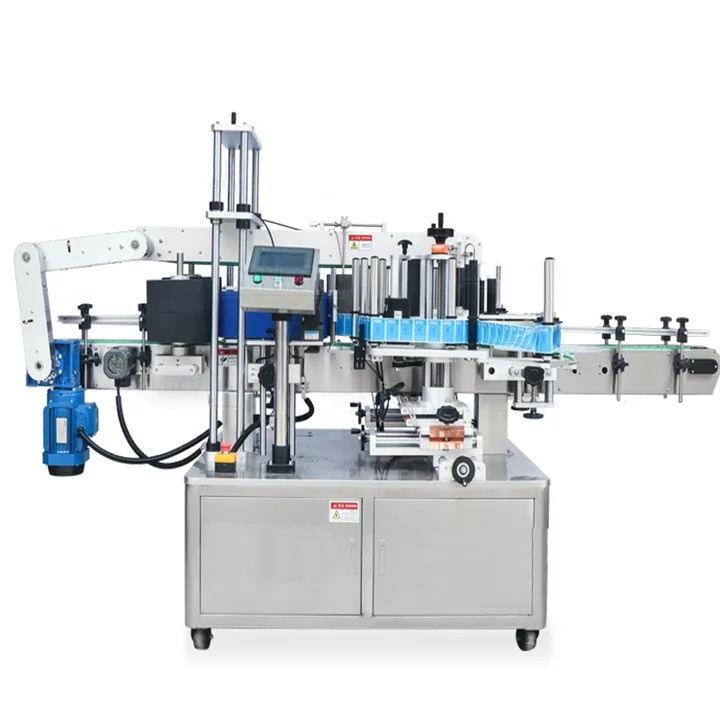
Twin-side in one pass
Useful when both label panels are accessible and the pack can stay oriented through two opposing heads.
Jerrycan labelling
Front and back label application for handled, wide and heavier containers where product control, filled weight and label-panel geometry shape the machine route.
Large handled containers
Jerrycans and larger handled bottles can present broad label panels, but the pack is often asymmetrical, heavier when filled and less rigid than it appears. The handle, cap, moulded ribs and recessed panels can all change how the container travels between guides and side belts.
A front and back labelling route can apply branding and product-information labels in one pass when both faces remain accessible and the pack can be stabilised without distortion. The correct setup depends on the real filled weight, wall stiffness, base condition and labelable panel.
Handling assessment
| Handle and closure | An offset handle or projecting cap changes the centre of gravity and can restrict a top hold-down. Confirm the orientation that reaches the labeller. |
|---|---|
| Filled weight | A filled pack may run more steadily but needs suitable conveyor support and controlled acceleration. An empty flexible pack may distort under guide pressure. |
| Recessed label panel | The label must fit inside the usable panel with enough clearance from radii, ribs and mould seams for reliable wipe-down. |
| Surface condition | Oils, release agents, dust, moisture or low temperature can affect adhesion. Trials should use representative production-condition packs. |
| Label size | Large labels need consistent dispense, liner control and pressure across the full face. Record label width, length, gap, web and roll dimensions. |
| Product spacing | Wide containers need adequate pitch so both heads complete application before the next pack enters the control zone. |
Machine route
Useful when both label panels are accessible and the pack can stay oriented through two opposing heads.
May suit low-volume work or packs that cannot be controlled reliably between opposing belts, but it adds handling and orientation steps.
Needed where a third label, top label, neck label or separate coding/inspection station is part of the finished pack.
Sample trial
Review the container panel design guide, the placement measurement guide and the FAT and SAT checklist before fixing the machine scope.
Include container dimensions, filled weight, photographs of the handle and label panels, both label specifications and the required line rate. Lancing can then identify the most suitable handling and applicator arrangement.