Product control
The pack must not rotate, rock or change speed between heads. Heavier or asymmetrical products may need longer stabilisation contact or more controlled spacing.
Multi-panel labelling
Configuration-led labelling systems for packs that need a third label face, top label or specialist sequence beyond a standard twin-side machine.
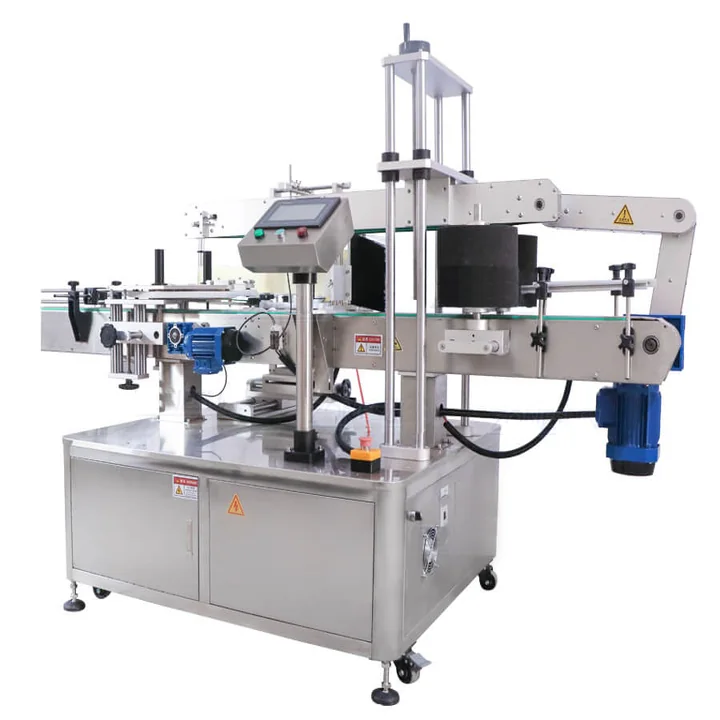
Configuration-led system
A standard twin-side labeller is designed around two labels on opposite faces. A multi-panel project adds another application point: a third side, a top label, a neck label or a separate information panel. The extra head must be planned with the product path, label order and available contact area rather than added as an isolated accessory.
Separate label heads allow each label to have its own roll, sensor, vertical position and dispense timing. The pack still needs one stable datum throughout the sequence, so guides, side belts, top hold-down and product spacing become more important as the number of application points increases.
Face-by-face planning
The engineering brief should describe every label face, the order of application and the point at which each label can be pressed onto a stable surface.
| Opposing front and back faces | Usually handled by two side-mounted applicators. Define independent label datums and wipe-down for each face. |
|---|---|
| Third side or narrow panel | Check whether the panel remains accessible after the first labels are applied and whether the container must be turned or re-oriented. |
| Top, shoulder or neck | Confirm the labelable area, curvature, closure overhang and whether a separate hold-down or application tool is needed. |
| Top and underside faces | Normally requires a split-belt or transfer arrangement rather than a conventional side-head layout. |
| Variable-data label | Define whether the data is pre-printed, printed inline or verified after application. The print field and camera view affect head position. |
Engineering sequence
Every additional head adds a timing, access and changeover requirement. A useful trial checks the complete sequence rather than demonstrating each head separately.
The pack must not rotate, rock or change speed between heads. Heavier or asymmetrical products may need longer stabilisation contact or more controlled spacing.
Operators need room to load rolls, thread liners, clean sensors and reach adjustment points without disturbing another head.
A format change may involve several roll specifications, sensor settings, head positions and delay values. Record the complete format, not only one label.
The first label must be secure before the pack reaches another belt, guide or applicator. Fresh label edges should not be lifted by subsequent contact.
Printed data, barcode orientation and camera line-of-sight should be agreed before applicator positions are fixed.
Define what happens if one head has no label, a roll ends or a product gap appears. The response may be line stop, reject or controlled recovery.
Trial checklist
For two opposing labels, compare the automatic twin-side labeller. For upper and underside labels, see the top and bottom labelling machine. For a third neck or shoulder label, use the front, back and neck application guide.
Send a marked-up container drawing, production label rolls, pack samples, output requirement and details of any coding or inspection stage. Lancing can review the application sequence and confirm which machine route should be trialled.