Body labels first
Often useful when side belts provide the main product datum, provided later neck-label contact does not disturb fresh body-label edges.
Multi-head bottle labelling
Multi-head bottle labelling for two body labels plus a neck, shoulder or closure label, planned around product control and the complete application sequence.
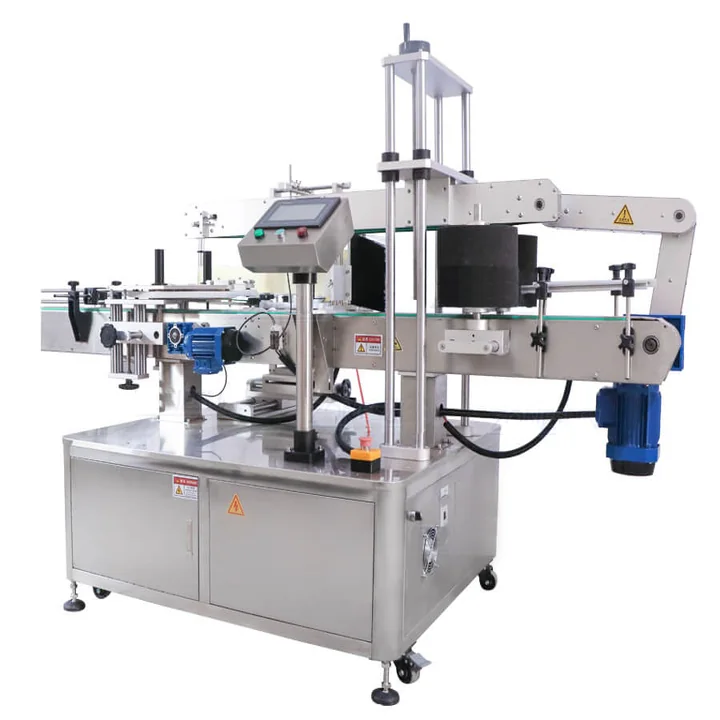
Three-label bottle route
A bottle that needs two body labels plus a neck, shoulder or closure label is a multi-head application. The third label should not be treated as an afterthought: its shape, curvature, orientation and wipe-down method can influence product control and the order in which labels are applied.
Front and back labels normally use two side-mounted applicators. A neck or shoulder label may require a separate head, a dedicated application tool or a different product orientation. The final arrangement must be established from samples and a marked-up drawing.
Application map
| Front label | Nominal datum, horizontal and vertical tolerance, label material, artwork orientation and any clear area around a panel radius. |
|---|---|
| Back label | Independent size and position, barcode direction, mandatory information area and relationship to the front label. |
| Neck or shoulder label | Surface angle, circumference, closure overhang, label shape, overlap if any and the pressure method needed to follow the curvature. |
| Tamper-evident label | State the required finished function and the surfaces it bridges. This may need a specialist application and product-specific validation. |
| Print or inspection | Define any batch code, date, barcode or camera check and ensure the label remains visible to the printer or inspection system. |
Sequence selection
Often useful when side belts provide the main product datum, provided later neck-label contact does not disturb fresh body-label edges.
May help when the neck application needs open access, but the applied label must tolerate downstream guides and hold-down devices.
Can be more practical when the third label needs a very different orientation, dwell time, inspection method or changeover routine.
Acceptance brief
Send the closed bottle, all label rolls, a marked-up drawing and the target line rate. Lancing can assess whether the third label should be integrated into one machine or handled by a separate station.