Oval bottle labelling
See how changing curvature and fill condition affect control.
Practical answer
A top hold-down belt is useful when the pack tends to lean, pitch or lose vertical control, provided there is a suitable top contact surface.
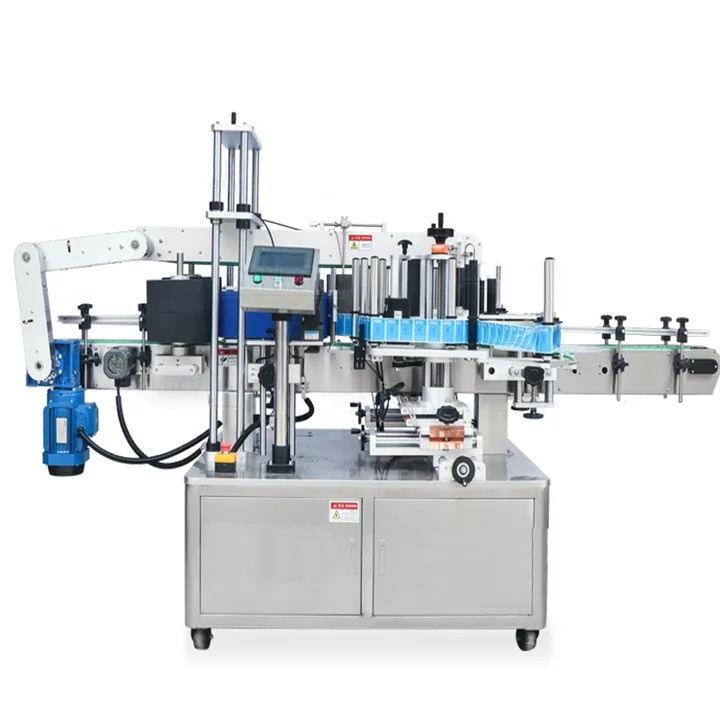
A hold-down decision depends on the top surface presented by the complete closed pack. Cap height, pump or trigger geometry, closure tightness and tamper-evident features can determine whether overhead contact is stable or damaging.
Document the permitted contact zone and test every approved closure variant before treating one height or pressure setting as transferable.
A top hold-down limits vertical lift, pitching and leaning while the container is accelerated, guided and wiped down. It is particularly relevant where a tall or light pack has a narrow base or where side contact alone cannot keep the label panel at a repeatable height.
It should stabilise the pack, not force it into a new shape or act as the only orientation device.
The contact should be on a repeatable, mechanically suitable top surface that can accept the required pressure without marking, loosening or distorting the closure. The belt path must also clear shoulders, handles and changing heights across the approved format range.
Document the contact zone and height setting for each recipe, especially when cap or closure variants share the same bottle.
Yes. A pump, trigger, flip-top, overcap or loose closure may offer an unstable or damage-sensitive contact point. Overhead contact can also alter orientation if it catches an asymmetric closure.
Where there is no suitable top surface, the handling design may need stronger side control, a lower contact band, controlled infeed orientation or another pack presentation method.
Run the full height and closure range at the intended fill condition and normal product gaps. Observe starts, stops, transfers and any accumulation pressure. Check for cap marking, closure movement, bottle deformation, label-position drift and recovery after a gap.
Record the height, contact pressure or adjustment reference, belt-speed relationship and the accepted closure variants so the setting can be repeated.
| Pack behaviour | Top-control question | Alternative to consider |
|---|---|---|
| Tall bottle pitches forward | Is there a stable top surface at a consistent height? | Longer side-control zone or improved conveyor transfer |
| Pump or trigger projects above pack | Can the belt avoid the actuator and preserve orientation? | Side belts, guide rails or oriented infeed |
| Flexible shoulder collapses | Can contact move to a stronger closure or neck area? | Lower pressure, broader contact or pack redesign |
| Several closure heights share one line | Can the height setting be changed and recorded safely? | Separate format procedure or different control device |
Related answers
Use the most relevant next page rather than treating one answer as the complete machine brief.
See how changing curvature and fill condition affect control.
Review closure orientation and top-contact constraints.
Compare guides, side belts, hold-down and orientation methods.
Send container photographs or drawings, both label specifications, the target output and details of the surrounding line. Lancing can confirm the most suitable machine route and the evidence needed for a sample trial.