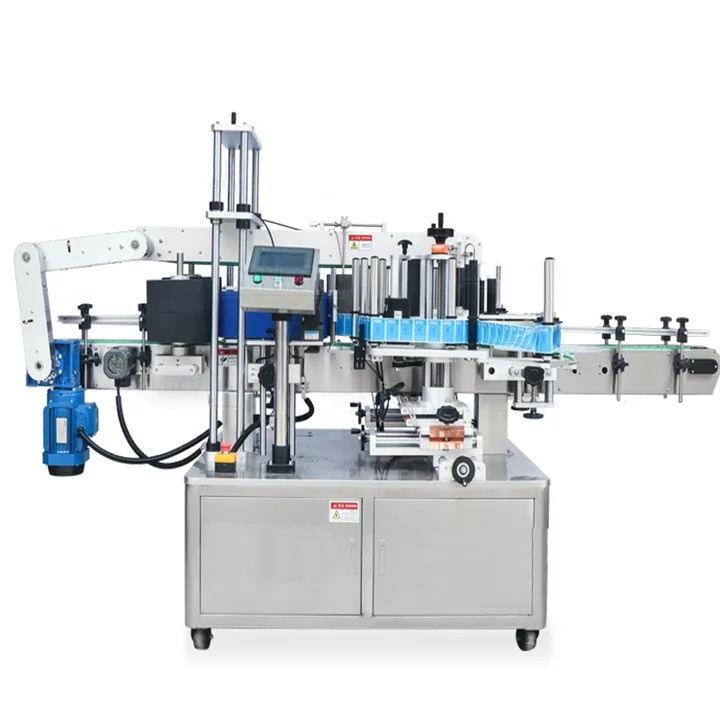
Automatic twin side labeller
View the automatic machine route.
Machine route
Bottle front/back labelling machines apply separate front and rear labels with repeatable positioning for retail, compliance and product information.
Flat, oval, square and rectangular bottles are common front/back labelling applications. Round bottles can also be suitable where two separate labels are required instead of a wraparound label.
The finished label layout and bottle stability should be checked before selecting the machine.
Compact twin-side labellers can suit smaller batches, limited space and lower output. Automatic twin-side labellers suit continuous production and integration with filling, capping, coding and inspection equipment.
The label material affects sensor selection and finished accuracy. Clear labels, film labels and reflective materials should be checked before the equipment is finalised.
The label panel, bottle taper and edge positions also affect how the label looks on the finished pack.
A strong enquiry should include bottle photos, label dimensions, target output and line context. This helps avoid a generic recommendation that does not match production.
Related routes
Use these pages to compare nearby machine routes, applications and buyer guides.
View the automatic machine route.
See front/back labelling for flat bottles.
Read the UK bottle labelling machine buyer guide.
Quick answers
A twin side labeller is usually the starting point for separate front and back labels on suitable bottles.
Many machines can be adjusted, but the exact size range and changeover needs should be confirmed.
Yes. Send the pack and label details so the correct route can be shortlisted.
Send pack photos, label sizes, target speed and current line details. Lancing UK can help shortlist the best front/back labelling machine route.
Bottle-shape control
A bottle front and back labelling machine should be selected from the usable label panels, bottle stability and required orientation, not from overall width alone.
Check panel flatness, mould seams, recesses and whether opposite faces are parallel. Guides should reference a stable surface away from the label zone.
Side pressure can rotate the pack as the curvature changes. Belt position and contact length should be trialled with filled production samples.
Confirm whether the label stays within one face or approaches a corner. Small orientation changes can make the label appear skewed against a vertical edge.
Provide top and bottom panel dimensions and the labelled condition. Taper can require artwork compensation, while flexibility limits allowable belt pressure.
This page covers bottles needing two discrete labels on opposite faces. For a round bottle needing one continuous label, use the dedicated wraparound labelling route. For a broad comparison of semi-automatic, wraparound, front/back and top/bottom bottle labellers, use bottlelabellers.co.uk.
Where a third label panel, corner application or variable-data print-and-apply is required, provide a drawing and treat it as a separate application rather than assuming the standard twin-side arrangement. The bottle handling and orientation guide explains the main presentation checks before a trial.
| Bottle sample | Normal material, colour, fill condition, closure, dimensional variation and any seam, embossing, handle or recessed panel. |
|---|---|
| Label sample | Both finished rolls with face stock, adhesive, liner, gap, core and winding direction. |
| Position drawing | Front and back datums, label orientation, horizontal and vertical location, keep-clear zones and allowed skew. |
| Production method | Target normal output, product spacing, manual or automatic feed, upstream/downstream machinery and available conveyor space. |
Specification questions
These additional points cover bottle condition, material and the need for physical samples.
Test them in the same condition used at the labelling stage. Product weight, cap fit and bottle stiffness can change stability and side-belt pressure.
They may require different guide, belt and wipe-down settings. Surface energy, rigidity, mould variation and breakage risk should be considered separately.
They are strongly recommended for oval, tapered, lightweight, flexible or clear-label applications because drawings do not show every handling and adhesion variable.