Mechanical comparison
Check for loose adjustment points, contaminated rollers, damaged peel edges, liner build-up and uneven take-up.
Fault-finding guide
A structured fault-finding route for twin-side and multi-head labellers, from pack handling and sensing to web tracking, wipe-down and speed.
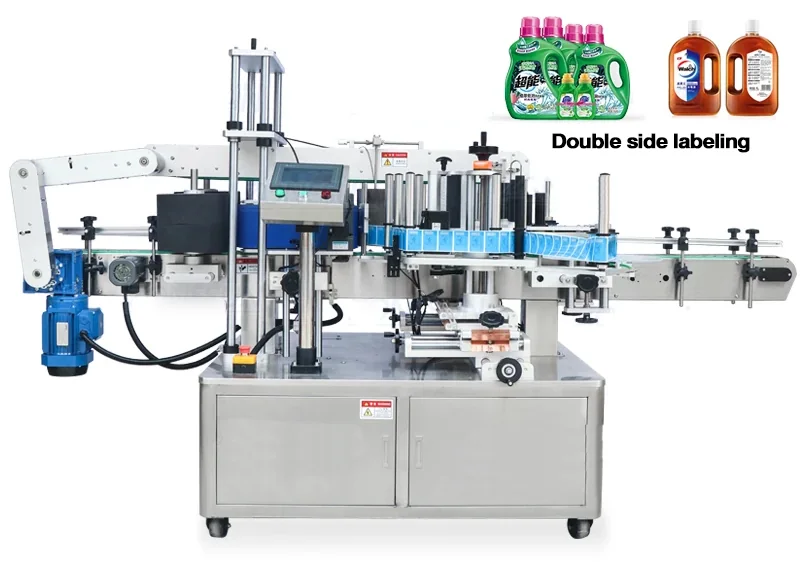
Front and back labelling faults often have more than one possible cause. Changing several settings together can hide the real problem and make the next format harder to reproduce. Work from the pack path to the label path, then the application contact and running speed.
Symptom table
| Both labels drift together | Check product position, conveyor speed, common trigger, container movement and changes in pack spacing. |
|---|---|
| Only one label drifts | Compare that head’s sensor, roll, web path, delay, dispense speed, peel plate and wipe-down. |
| Label is consistently offset | Verify the nominal datum and recipe setting before treating a repeatable offset as random variation. |
| Label skew varies pack to pack | Look for container rotation, rocking, unstable guide contact, varying fill weight or inconsistent wipe-down. |
| Wrinkles or bubbles | Check panel geometry, label size, application angle, wipe-down pressure, surface condition and label construction. |
| Edge lift or flagging | Check panel radius, mould seams, contamination, adhesive suitability, storage condition and later guide contact. |
| Missing label | Check product sensing, label sensing, roll end, liner break, head-ready signal and fault recovery. |
| Double feed or wrong gap | Inspect the label gap, transparent construction, sensor teach, liner variation and web tracking. |
| Front/back mismatch | Confirm both recipes, roll identity, artwork orientation and whether one head recovered differently after a stop. |
| Fault only at higher speed | Review product spacing, acceleration, label dispense, belt contact, liner take-up and downstream restriction. |
Twin-head diagnosis
Where two similar heads apply labels to the same pack, the stable head provides useful evidence. Compare roll construction, sensor status, web path, head angle, peel-plate position, wipe-down and recorded settings. Do not assume the heads should have identical values: front and back labels may differ in size, material and required position.
Check for loose adjustment points, contaminated rollers, damaged peel edges, liner build-up and uneven take-up.
Review sensor indication, alarms, product trigger, encoder relationship and the selected recipe without changing multiple parameters.
Swap only when authorised and useful. Different label or liner batches may behave differently even when artwork looks identical.
Specialist guides
Pack shape, wipe-down and label construction.
Surface condition, adhesive and storage.
Opaque, film and transparent label detection.
Roll alignment, tension, peel plate and wipe-down.
Record the product format, label batch, settings, speed, alarm history and clear photographs or video of the fault. Lancing can use that evidence to distinguish an operator setup issue from a material, sensor, handling or mechanical problem.